
 I opened this blog on 8/12/2007 to report my Princeton days and I went back to Japan in March 2009. I've abandoned it for almost a year. To restart the blog, I change the title from "matsutake: living in america" to "living in Tokyo."
It took some time to readjust myself to the life and work in Tokyo, but now I'm OK because I've established the rhythm of run, write, and bento.
I keep running and the distance I've run so far is 726 mi, I even tried a half marathon in February. The time was 2 hr 2 min but my wife ran at 1 hr 54 min. I'll beat her in the half in April!
I also keep writing a book, papers, abstracts for conferences, and grant applications. I found that writing was very similar to running as Haruki Murakami wrote in his wonderful book What I Talk About When I Talk About Running. Now in spring vacation (for students, not for faculties) I try to write four thousands characters a day. It's not easy but setting daily goals is the best way to achieve the big thing, which is same with running. Also, to my happiness, teaching, as well as writing, is a lot of fun!
I started to make bento (lunch box) everyday since January. It's very fun and need some intelligence and creativity to make beautiful and healthy bento box. The photo is today's bento. I always uploads the photos to Facebook. Some friends like them and that is a big motivation to keep making!
Running + Bento = losing weight and getting healthier, which create academic productivity. I'm happy about it and try my best to keep the rhythm!
3/01/2010
Run, Write, and Bento

2/22/2009
4 weeks
It's mid-February and that means I have only four weeks to stay here... I have booked the airticket and told the housing office the vacate day of my apartment. I hope to write up a methodological paper on using a content analysis of media discourse to analyze social meaning of consumption, and also finish a first draft of the book on the healing boom. Knowing that not so much time have been left, the list of things-I-wanna-do-before-leaving-Princeton have been longer and longer. That's why I'm attending the cooking class at the adult school to learn how to make bread and soup. I also see movies. Milk is the best movie I've ever seen in the US and Pink Panther 2 was just a garbage. I have collected DVDs such as the Office and 30 Rocks. I'll be able to enjoy them using a region free DVD player I got here.
I am also preparing the lecture that I'll start from April (In Japan, the academic and the fiscal year starts from April, the season of cherry blossom). Since I'll have three or more talks at academic meetings during the next semester, which is from April to July and is called "summer semester" in my home university, I want to finish every materials for the lectures in March. I haven't taught for one year and half, so I'm very excited to do it again.
Anyway, I should think I'm too busy to do any unnecessary things. But, you know, the more you are busy, the more you want to do unnecessary things. That's why I reorganized my website. OK, let me go back to work.
12/19/2008
11/30/2008
50 mi more
LONG LONG LONG time no see and happy holidays! I'm OK and just hope you are, my fellow Americans. Last post was in June and today is the end of November, to my surprise. There are only three months and half to stay in the US and my home university has sent a bunch of emails about the lectures I'll teach in next academic year (In Japan, academic year starts in April, the season of cherry blossoms). Yeah, time flies, especially the time for sabbatical. The presidential campaign had started at that time when I arrived here in last August and lasted till this November. During this period, two Japanese prime ministers resigned, to my surprise again. I bet you don't know them. As I wrote last year, the first resignation wasn't reported by the US media because of Britney Spears' awesome/awful performance at the MTV Music Award, and the second one wasn't either due to the unexpected appearance of Sarah Palin (by the way, most talented person I found in this campaign is not Barack Obama, but Tina Fay). I just hope the incumbent guy, Taro "Rosen" Aso, will not resign until next March. Anyway, I should be more productive than I was.
Another concern is a weight control. The problem is American food. At first, I thought how big the portion of meal here and how salty they are, and how sweet sweets here are. But now, my taste became Americanized. My stomach accept any kind of food and I really like American sweets. So, it's quite natural that I gained my weight and couldn't wear clothes I brought from Japan. And the bad thing is my wife, now living in Berkeley, California, lost weight surprisingly because she uses a bicycle to go to and from her office. And the worst thing is she often boasts how much she lost like "I wanna have a new belt because it's too long." Hey, we didn't talk about your stupidly long belt at that time and it was totally out of the context. And to my surprise again and again, she said she started jogging. That lighted me fire. To beat the woman, who now pretends to be a health conscious Californian, I also started jogging from August with the aid of Nike+.
Here is the result. Year, I ran one hundred miles so far and lost ten pounds from August. Now I recover the weight I had when I entered this county. But, as people here did in Thanksgiving, I had too much meal, so I'm afraid that I gained weight again. So, I promise you to run fifty miles in December. It's a challenging goal, but by this declaration, I want to show my commitment.
However, I want to emphasize at the same time that I won't sacrifice the joy of eating for the sake of diet. The well known belief that American food are not delicious and bad for health aren't necessarily true. If you carefully choose what you intake, you can enjoy the diversity of wonderful foods here and will not gain weight. You cannot enjoy so many kinds of sandwiches in Japan. You cannot enjoy such interesting sauce like mango dressing for sea bass in Japan. You cannot enjoy authentic Hong Kong style dim sum, Mexican fresh salsa, cram chowder both in Boston and New York, crab cake in Baltimore, and Californian fusion cuisine, in Japan.
Anyway, give me your loud cheer to accomplish fifty miles run!
6/04/2008
Every Barber Knows That
How to order a haircut? I believe it’s very important issue for people living in foreign countries. Since I came to the US, I've got haircuts for three times so far. The first two experiences in barbers were just disaster. Guess whom I found in the mirror in front of me just after the barber handed me my glasses at my first visit to a barber’s. Answer: Asian Mr. Spock with glasses. Certainly, some male here don’t have their sideburns, but it’s not common in Japan. My basic principle to live in the US is “When in Rome, do as the Romans do,” but I just cannot accept this American way of sideburns. The problem is that I cannot see the process of haircut because I have to take off my glasses during the haircut. My friend, who listened to my compliment, told me that when I make an order, I should put both index fingers on my sideburns and clearly ask the barber to keep them.
So, at the next time, I visited a different barber’s on the same street and made an order as my friend instructed. I also asked the barber to show me hair sample photos and selected one of them to make sure my order. Guess whom I found in the mirror in front of me just after she handed me my glasses. Answer: Asian Mr. Spock with glasses and sideburns. I was so surprised to see slightly upgraded Mr. Spock again in a different barber's that I lost my words to claim her that mine was totally different from the sample. Instead, I was impressed by the fact that American barber industry shares such a standardized technique to cut front hair so shortly and neatly to make the bizarre horizontal border line between front hair and forehead.
Finally I got an important lesson: I should not use barbers because for them sideburns and long and unordered front hair are the deadly enemies to be eliminated from this earth. So at the third time, I visited a hair salon in a shopping mall. The price was higher, but I was satisfied with the result. Actually, more important is that I was prepared because I checked the vocabulary for haircut order through the Internet like this: “Today, I just want you to trim and thin out my hair because it’s too thick. Please cut my side and back hair a little bit, but don’t cut the front hair. Also, I don’t want to clean up my sideburns, OK?”
Today I’m going to cut my hair for the first time after two months. I’ll visit a hair salon again instead of a barber’s just because I’m not sure a barber will listen to my request. I just hope this time will be successful. If you know the better way to order, just tell me immediately.
5/23/2008
Hooters Experience
 To celebrate my friend’s return to Japan, we visited Hooters, the American restaurant chain, which is famous for sexy waitress. I have been interested in this restaurant, but I felt somewhat ashamed to visit alone, but I could find the good reason to do that finally.
Yes, the waitresses there, Hooters Girls, are very sexy. To me, it sheds light on some of the values shared in American society: especially what is sexy to people here. The waitresses wear their uniform of a white tank top with the Hooters owl logo and the location name (Princeton! Isn’t it funny?) on the front paired with the short orange runner's shorts. In Japan, there is no such a restaurant chain which sell not only foods but also sexiness, with one exception, Anna Miller's. This restaurant is also famous for the waitresses’ “sexy” costume. Wikipedia explains that these consist of a white blouse; an orange or pink miniskirt jumper-style dress, with the waistline cut underneath the breasts; a matching apron; and a heart-shaped name tag (I haven’t visited there actually). Anna Miller’s were originally from Hawaii, but the costume in Japanese Anna Miller’s is different from Hawaii’s one. What is interesting to me is that this costume and the girls in Hooters seem to represent American males’ taste on female sexiness, and those in Anna Miller’s do Japanese taste, and they show sharp contrast. Hooters’ outfit is more scanty, and Anna Miller’s one is more elegant maids-like (but still sexy, I guess), which resemble to the costumes used in anime-inspired Maid Cafes in Japan. What I want say is that what is sexy to American (males, and females too) is much more open and casual than Japanese one.
Hooters sell many kinds of merchandises too. White T-shirts with the Hooters owl logo and the location name (Princeton! Again, isn’t it funny?) on the front is 10.99 dollars. Good price. They also sell a white tank top with the Hooters owl logo and the location name (Princeton! Again, isn’t it funny?) on the front, which waitresses wear. How much do you think is it? IT IS THIRTY FIVE DOLLARS! They are really doing good business. Their pricing is wise because they know that the simple fact that the waitresses wear them adds special value on these tank tops (I strongly believe that the cost of the tank top is not so different from T-shirts one). This tank top is the symbol of the enjoyable experience in the restaurant, and also fun communication with waitress (For example, they generously accept costumers’ requests to take pictures). Also, it could be good small topic to talk with your friends if you bring it to party or something. Some of T-shirts are for youngsters. Boys’ T-shirts come with the logo of HOTTERS LADIES MAN, and girls’ one has FUTURE FOOTERS GIRL. I’m not sure that parents here allow their children to wear them and they could be appropriate gifts for your nephews and nieces, but I like this kind of sense of humor.
 So, I bought one T-shirts for myself (My friend also bought two! Good souvenir.). However, I guess wearing it in Princeton is a bit dangerous. I also got one tank top for my wife because today is her birthday. She is not Hooters Girls type (the opposite, I should say). I just hope that she will understand my sense of humor.
2/15/2008
Valentine's Day
Today is Valentine's Day. I saw many customers in the flower shop beside my office. According to Wikipedia, it is the traditional day in North America and Europe on which lovers express their love for each other by sending Valentine's cards, presenting flowers, or offering confectionery. My American friend told me that this reciprocal gift exchange is mainly done by young couples before marriage.
So Japanese Valentine’s day is rather distinctive holiday form Western standpoint. Why such differences? While, generally speaking, the origin of customs shared in societies is very difficult to trace, the creator of Japanese Valentine’s day is well known: Kunio Hara, the CEO of Mary’s Chocolate Company. This confectionary company was founded by his father in 1952. Hara, who worked at his father’s company as a part time worker, received the mail from his senpai, an elder friend or mentor, who worked as an employee at the trading company in Paris. The senpai wrote him that French had a custom that lovers send flowers, cards, and chocolate each other on February 14. This letter made him to propose his father to utilize this European custom to sell their chocolate products and gained his father’s approval. His first attempt in 1953 was totally failed. At the shop in Isetan, the department store in Tokyo, he sold only three packages during three days of the sale because Japanese were unfamiliar with this custom.
However, his father gave Mr. Hara another chance to hold the sale in the next year. He created new products such as heart mark shaped chocolate and constellation mortified chocolate. He also devised the service to engrave the names of both the senders and receivers on the chocolates at the shops. Most important decision he made was about his campaign that targeted single women customers. He advertised that on Valentine’s Day women were allowed to confess their love to men. At that age, it was unthinkable for the majority, who believed women should obey men’s initiative in any aspects, that women confess love to men. One the other hand, it was also true that traditional norm that limited Japanese women’s liberty had been disappearing little by little after the WWII. Hara utilized the gradual improvement of women’s status.
His marketing effort made female consumers recognize this holiday gradually, but it became very popular after many magazines, wihch were created in 1950s and 1960s to target young female readership, reported Hara as the creator of Valentine’s Day. Now, sending chocolate on this day is still as important as the traditional seasonal gift-giving custom such as chugen and seibo.
Contrary to Valentine’s Day, the origin of White Day, the men to women day, is not clear. According to one theory, a marshmallow maker started marketing to men on the grounds that they should pay back women with marshmallows. After that confectionary companies joined this campaign, this return gift also become common. Now, the kind of appropriate gifts for White Day is more diverse than Valentine’s Day from white chocolate to candy to gem to lingerie.
2/09/2008
Rabbit, Eel, and Damburger


A good tip for Japanese English speakers, which I found on the Internet, is to shout the Japanese word for "rabbit" before speaking English. The word usagi is one of rare Japanese words that force speakers to move their mouths clearly. As you can imagine, you must make your lip rounded and smallest to pronounce "u" (as in food and zoo), but, on the contrary, "sa" forces your mouth biggest (as in father), and then, "gi" makes yours flattest (as in eat). So, I shout "u! sa! gi!" several times every morning. While it sounds really stupid, it's very helpful.
Today I discovered another Japanese word that works in the same way, ell. In Japanese, eel is unagi. Grilled unagi is Japanese favorite. It's often eaten during hot summer because unagi is rich in protein, calcium, vitamin A and E, and it's said to give people stamina. I haven't have it so far in the US because frozen unagi sold in Asian supermarkets look not so fresh, and therefore, not to contain enough stamina. Anyway, I will say unagi tomorrow morning.
By the way, the French people, who eat usagi, also have the difficulity to pronounce correct American English as shown the video below. Check it! I would like to buy a damburger.
2/01/2008
Productivity and Weight
 Long time no see. I haven't posted the blog about two months just because I was a little bit busy. I did some field work at New York Anime Festival, wrote a paper and prepared a small presentation at the conference during the holiday, and enjoyed the holiday with my wife from Japan in NYC and Princeton. I managed to submit my paper and finish my presentation in Florida without problems (I guess).
However, I am gaining my weight little by little. While I don't weight myself on a scale, my pants are now too tight. I believe that I am careful of my diet, but I recently haven't visited the fitness gym. When I was in Tokyo, I used the commuter train, but here, I use a car to visit my office, so I seldom walk as I did. In addition, I keep sitting at the desk almost all day because I have no teaching obligation. I should find an opportunity to burn my fat, but it is troublesome to visit the gym in such an cold weather. It is basically around 30 degrees Fahrenheit (the freezing point of water is 32 degrees)!
Productivity of the research and my body weight apparently have a positive relationship. Making it negative is my aim in February, of course, without reducing the former.
12/03/2007
Season's First Snowfall
 This Sunday morning, I saw the first snowfall of the season. Until I started to live in Tokyo at the age of eighteen, I was in Hokkaido, the northern island of Japan. My high school was in Sapporo, the capitol of Hokkaido. It is best known outside Japan for hosting the 1972 Winter Olympics, and the Sapporo Snow Festival, which draws more than two million tourists from around the world. Therefore, snow was my old friend. Playing with snow, skiing, and ice skating were best winter entertainment for kids in Hokkaido.
However, I have little wisdom for living in the snowy country. Most serious is that I have no experience to drive a car in snowy winter. Before the driving to my office, I checked the Internet to find the tips for driving on frozen roads. OK, now I got the theory of winter driving, but what I need is a practice. Unfortunately (or fortunately) the road was not frozen enough to try my knowledge. It's snowing even now, so the road may be icy at night. I'd better go back home earlier today.
Winter in the US is a biggest season for shopping. From Black Friday to the Christmas, retailer s are eager to loosen the consumers' purse string. Vecere Jewelers in NJ is no exception. Their ads says,
If it snows 4 inches or more on January 1, '08 we will refund your full purchase price on any in-stock jewelry, including designers!
 The purchase from November 23 (this year's Black Friday) to December 24 is eligible for the rebate. The snowfall is measured at the Weather Measurement Station at Trenton, Mercer County Airport on January 1, 2008, between the insured hours of 12:00 AM and 11:59 PM (24 insured hours).
Let's pray for heavy snowfall only on the new year day. Also, please pray for my driving safety in winter. Thank you in advance.
11/26/2007
50 State Quarters

But I sometimes use cash recently because I need Quarters for two reasons. First, I need them to wash my clothes. The washing machine and the drier at the public space of my apartment accept only Quarters. To wash and dry my clothes, I need four Quarters in total. It was very sad that I found the other day that I couldn't wash my cloths due to the lack of Quarters and finally went to the convenience store to get them.
Second, I started to collect fifty State Quarters. The 50 State Quarters program is the release of a series of commemorative coins by the United States Mint. Between 1999 and 2008, it is intended to feature each of the 50 individual U.S. states on unique designs for the reverse of the quarter (cited from Wikipedia). They are good tool to learn the history and the character of each state. Delaware Quarter says that it's "the first state." Washington Quarters, "evergreen state," features salmon leaping in front of Mount Rainier. North Dakota has two bison at dawn and badlands, and Kentucky does thoroughbred racehorse behind fence.
Also, they are useful to learn the location of each state. To understand the geography of this country, I bought 50 State Commemorative Quarter Map Holder Album Book. The seller of this album raises ten reasons to buy it on their website. It's interesting that most of them feature financial reasons such as saving and investment. It's very American for me. If Japanese Ministry of Finance issued this kind of coins and somebody tried to sell coin albums in Japan, they would feature the educational utility on their advertisement. By glancing the marketing communication of such small products, we can easily find the cultural difference of the notion on money.
By the way, I visited my colleague who also enjoys his sabbatical in Pennsylvania two weeks ago. His family entertained me with authentic Japanese food, the udon with homemade tempra (a deep fried lightly-battered vegetables and seafood). It was yummy! Thank you very much, Karube-san. After the fine lunch, he showed me his daughter's coin album. It seems that I, a thirty five years old man, shares same hobby with a nine year old girl. Am I childish? Yes, I am a cultural child here.
Luckly every commemorative coin will be released during my stay in the US. To grow up, I will complete this collection.
11/04/2007
Japanese Manga Industrial Complex

What was striking for Pink when he visited the market of dojinshi was flagrant copyright violation. Most of them sold there borrow liberally from existing professional works such as Dragon Ball and Evangelion. It's no wonder that he was wondering why Japanese publishers doesn't bring a law-suit against them. The scale of the market is incredibly huge. At Super Comic City, two days dojinshi market at Tokyo Big Sight (Japan's largest exhibition oriented convention center), he saw 33,000 dojin artists sold their comics in six huge halls, each the size of a professional basketball arena. About 300,000 books are sold in cash totaling more than $1 million by day's end.
The main organizers of dojinshi markets answered this American question with Japanese-like phrase, anmoku no ryokai, which literally means "unspoken, implicit agreement." Needless to say, publishers never encourage dojin artists to violate their copyrights. But they gave the creators their tacit permit. Pink explains that this anmoku no ryokai is an imperfect but calcurated business model of manga publishers in Japan. He articulated it in three ways. First, the dosinshi devotees are good manga's customers. Second, dojin creators are the huge pool of potential talent. Third, by observing the trend of dojinshi market, they can predict the direction of professional manga market.
This article remembered me the last summer visit to Comic Market or Comiket. Comiket, the world's largest comic convention, is also held at Tokyo Big Sight every twice a year. Any space other than TBC doesn't have enough capacity for Comiket. Besides that, the number of the attendees continues to increase. Last winters's convention, Comiket 71, gathered approximately 440,000 attendees coverge in the course of three days, and Comiket 72 in this summer accepted approximately 550,000 attendees.
It is held during the hottest summer days in August and during the winter days after the Christmas in December. Apparently, these periods are not suitable for more conventional trade show such as motor show. Nobody wants to visit such an inconvenient place at the gulf of Tokyo at temperature over 100 °F. Also, every Japanese is very busy in December, especially after the Christmas, for preparation to welcome new year. But these scheduling shows the fact that the otaku (geeks) of dojinshi are the only people who don't take care of the climate which would cause sunstroke and can ignore Japanese conventional seasonal schedule to pursue their satisfaction.
Telling the truth, the gathering was really bizarre. Both physically and psychologically, the atmosphere was heated (and humid). Geeks with a bunch of one thousand yen bills were hunting their favorite dojinshi, most of them are the pornographic parody of manga as far as I saw.
But the cosplay (a portmanteau of the English words "costume" and "play") was very interesting. At the open space for cosplay, many people dressed as characters from manga and anime (an abbreviation of the word "animation"). On the contrary to the humid atmosphere around the dojinshi shops, cosplay space was a kind of amusement park. Many of handmade costume were highly sophisticated and some of cosplayer women are as beautiful as actresses. When they are asked to be taken their photographers, any cosplayers took their best pose professionally. It is regrettable that I erased the pictures of cosplayes by mistake.
This sanctuary for otaku has set many rules for attendees. Its phone book size catalogue, which contains information about the buyers and sellers, lists detailed Dos and Don'ts: Ask cosplayers' permission when you shoot them. Don't run. Carry a bottle of water. Be careful of your belongings. Don't bring five thousand yen and ten thousand yen bills to buy dojinshi. Use one thousand yen bill is strongly recommended so as not sellers to be in short of their changes.
Many unknown persons cautioned us about our "misbehaviors" during our two only hours stay. They have established many explicit codes to protect their growing sanctuary and expect any strangers to obey them. There isn't any anmoku no ryokai as far as Comiket is.
What is striking for me is the sharp contrast between their strict rules which dominate their cosmos and their obvious violation of the copyright rules which dominate their outer space. Is this enigma the key to understand how Japanese manga subculture have flourished?
10/20/2007
Lost in Translation

This movie is slow paced and doesn’t have clear story line. There is no car chase, explosion, or murder case. They just visit some places in Tokyo, drank at the hotel bar, and chatted on Bob’s bed sipping Sake, but never slept. Just as they are jaded tourists, this movie may be boring tourist pseudo-documentary for some audiences. It is probably surprising for them that Sophia won the Academy Award for Best Writing.
But I like this movie. Sophia vividly depicted the dry atmosphere of twenty first century Tokyo with simple camerawork: flamboyant westernized fashion among Japanese youngsters in Shinjuku and Shibuya, cutting edge posh hotel facilities, neon-fused downtown night, numerous people overblown on streets, noisy public announcement omnipresent in town and buildings, and so on. Of course, some description may be too stereotypical. She, however, succeeded to grasp the essence of Tokyo: the anonymity and anomie in a gigantic megalopolis and the boredom and anxiety prevailed in Japan who lost the status of an economic superpower in world economy.
Some customer reviews on Amazon.co.jp resented Sophia for making fun of Japanese accent in English which cannot tell the pronunciation “r” from “l”, and main actors for ridiculing Japanese sushi chef in English. But her portrayal is critical and precise enough for me, Japanese who lived in the town just five minutes by commuter train from Shinjuku, where the hotel is located, and now live in a foreign country alone (but, unfortunately or fortunately, I haven't yet met Charlotte-type woman here).
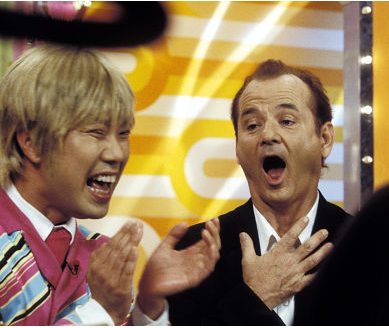
As California roll, popular sushi among American, isn’t authentic at all for Japanese, any foreign cultural stuff are translated though importers’ frame of recognition and localized by and large. So, picking and accusing the "inaccuracy" in this movie from Japanese standpoint is silly.
It’s interesting that, while this movie apparently deals with incommensurability among different cultures, it consequently describes the universal characteristics of our modernized world: incommensurability among family and friends. This homeless mind in individualized urban life may be shared among many Japanese. We are embedded in complex social structure but feel some uncertainty and loneliness, and this is what “Lost in translation” is all about.
10/11/2007
Tolbert and Zucker (1983)
Below is the summary of and comment on Pamela S. Tolbert and Lynne G. Zucker (1983) “Institutional Sources of Change in the Formal Structure of Organizations: The Diffusion of Civil Service Reform, 1880-1935,” Administrative Science Quarterly, 28 (1), 22-39.
Summary
This paper analyzes the diffusion and institutionalization of change in formal organization structure. Theoretical goal of this paper is to specify the boundaries between the rational and the institutional approaches to organizations clearly and confirm the central role of history in understanding organizations. Both approaches emphasize different aspects to understand the underlying diffusion of an innovation in the formal structure of organizations. The rational approaches point to the need for effectiveness or efficiency that may follow adoption. The institutional approaches point to the legitimacy of the organization in the wider social structure.
To reconcile the two approaches, the authors analyzed the adoption of civil service procedures by municipal governments from 1880 to 1935. Using available data, this paper answers two questions: What is the effect of explicit hierarchical legitimation of a reform, and What is the effect of rapid and widespread legitimation of a reform on its subsequent adoption? To answer the first question, the authors compare the effect of hierarchical control by the state with the effect of non mandated spread of reform on the rate of diffusion. To answer the second question, authors explore the change in the ability to predict adoption on the basis of particular organizational characteristics from the early periods to the later periods.
The first analysis reveals that civil service procedures were adopted much more rapidly by cities when the state mandated them and the process of adoption was directed by a single source. In contrast, when no state-level legitimation occurred, civil service procedures were adopted gradually, diffusing largely through social influence among cities.
The finding from the second analysis is much more important for the authors. They found that internal organizational factors predicted adoption of civil service procedures at the beginning of the diffusion process, but did not predict adoption once the process was well underway. They interpreted this finding as follows: As an increasing number of organizations adopt a program or policy, it becomes progressively institutionalized, or widely understood to be a necessary component of rationalized organizational structure. Also, they insisted that the legitimacy of the procedures themselves serves as the impetus for the later adopters. This finding means that early adopters of innovation are driven by rational reason, effectiveness or efficiency, but late adopters are by the legitimacy.
Comments
I enjoyed this classic paper well. It has both theoretical and empirical contribution. As for theoretical contribution, the authors succeeded to examine two theoretical approaches in the same empirical study. Although two streams of organization theory seem incompatible, both explanations are probably plausible for practitioners. They sometimes adopt innovations willingly to improve their internal process of the organization, and sometimes incorporate them into their formal structure to maintain their legitimacy. The authors explained clearly about this difference by the timing of adoption: an early adoption of innovation is driven by the adopters’ rational reason to improve their efficiency and/or effectiveness, and a late adoption by the pressure from their institutional environment.
As for empirical contribution, this paper figured out a unique technique to describe the institutionalization process empirically. To show the increasing power of the institutionalization through the diffusion process, the authors observed the predicting power of the model explaining adoption of civil service procedures by organizational characteristics such as percentages of foreign born and illiterate people, and city age and size. According to their analysis, the predicting power continued to weaken through the diffusion process. The authors interpreted it as the evidence of the legitimation and the institutionalization of innovation.
However, I may cast some doubt upon their empirical expression of the legitimation and the institutionalization. They did not show any direct evidence. Why could they insist that the civil service was institutionalized by showing the weaken power of the model? They seemed to assume that diffusion without rational reason meant legitimation and institutionalization of the innovation. But are rational and institutional reason either-or? It is possible to think that irrational cities adopt the civil service without feeling the legitimating pressure. They also assume that cities are rational enough to perceive how the innovation is institutionalized and to think that they should adopt it once if institutionalized. It is not necessarily clear what “rational” means in this paper.
This paper is nevertheless a successful research on a diffusion process in modernized society constituted by active agents in institutionalized context. We still can use the technique adopted by the authors to analyze diffusion process observed in our contemporary society. It is fair to say that the problem mentioned above cannot be solved easily as far as we deal with historical case. If we analyze recent diffusion process, we can observe it more directly. For example, we can adopt an interview method to grasp adopters’ and non-adopters’ intention and perception about innovation. By comparing interview and available data, we can gain deeper insight on institutionalization process.
10/08/2007
Farmers Market
 Trenton Farmers Market
Yesterday I visited farmers market. My host kindly took me to Trenton Farmers Market (He is really kind!). I (and my wife) like to visit local markets in foreign countries, which arose our imagination on locals' ordinary life. In this summer, we were lucky to visit Balinese local market. Check some pictures below. You can feel how different (and similar) Indonesian and American local markets are. In future, maybe when I am sixty-four, I want to conduct a research project on international comparison of local market with my wife, then we can visit many foreign countries. Bali, Indonesia
 Trenton, NJ, US
Trenton Farmers Market sell not only fresh vegetables and fruits but also various ethnic foods from Italian to Hispanic to Polish. I found many stuff not sold in supermarkets. Italian shop has diverse inventory of fresh cheese, Polish meats shop sells various kinds of ham and sausage, and Hispanic shop sells casual fast foods, which was inexpensive and delicious (Unfortunately, I forgot the name), as well as dry foods such as red pepper. Vegetables are very fresh. The assortment of each farmers are unique. Some farmer sell fresh tomato and basil. Other sell okra and coriander. By the way, "okra" is a Japanese loan word (in precise, we call it "Okura"). When I bought it in a supermarket a month ago, the cashier asked me the name of okra to input its unit price into the cash register (Here, supermarkets sell vegetables by weight and the cashier weigh them by the register, so each item should be put into each plastic bag by customer). I was at a loss for the answer, but the woman behind me said "Okra!". She, from Texas told me that okra was popular ingredients of BBQ there. We Japanese prefer lightly boiled Okra with vinegared soy source or Okra tempura.
Anyway, vegetables are very fresh and tasty. I stir-fried okra with some meat last night. This morning I made sandwich with tomato. Unlike vegetable sold in supermarkets, they have a flavor of vegetable. Okra is crisp and crunchy, and heirloom tomato has strong flavor. Considering this quality, the price is reasonable: okra is one dollar and half per one pound. This market is entertaining for me. Their display is beautiful. Finding vegetable not sold in Japan is curious. At the milk and egg factory shop beside the market, we can observe the manufacturing line of milk from the shop.
The building of the market is owned and maintenanced by local government. It seems difficult to maintain such markets which consists of small scale shops and farmers without financial and managerial support from the government. Do they compete or coexist with supermarkets? How many percent share of US fresh foods market do farmers markets have ? What is farmers' motivation to sell their products at the market by themselves as well as wholesale to retailers? To answer these questions, I should visit there again. Of course, I will.
10/05/2007
Pulp Consumption
There are many things I stop using after coming to US. One of them is business cards. In Japan, when we introduce ourselves at the first meeting, we always exchange business cards. So I must have carried my cards at any time. Even now I have some pieces in my bag, but there has been no opportunity to use them so far. I ordered two hundred pieces of my cards just before coming to US. But I don’t believe that I can consume them during my stay.
Another thing I don’t use in US is a handkerchief. Handkerchiefs seem to have given way to paper towels and napkins. To my surprise, every public restroom is equipped with paper towel. So, my handkerchief has been always kept in my pocket. Only chance to use it is perhaps when I cry. But I haven’t cry until now, unfortunately.
Why doesn't American use handkerchief? Wikipedia answers my question as follows. "Use of handkerchief instead of facial tissue paper is often seen as old-fashioned and, especially in North America, unhygienic". Oh, I see. That's why American doesn't. The following sentences are more interesting, "On the other hand, some see it as a more environment-conscious choice. In Japan and Sri Lanka, those carrying a handkerchief are considered to be well-educated." I didn't know that handkerchief was the proof of education.
Anyway, paper towels and napkins are omnipresent in US. You can use as much papers as you can anywhere at any time. In restroom, many men draw out too long roll of paper. In fast food restaurant, most customers take too many pieces of napkins. At first, I thought American waste more resources than Japanese do. Many Japanese thinks that US is more wasteful and Japan is more environmentally friendly. This impression may be rather correct. But as for pulp consumption, the difference between two countries seems not so large.
Omnipresent in Japan are tissue papers. In streets and stations, we often receive tissue packets with the flyer on the front. In huge terminal stations such as Shinjuku, getting five or six packets is not so difficult. We welcome and carry them in our bag because some of public toilets in Japan don’t have toilet paper as well as paper towel. Also, in spring, many Japanese who suffer hay fever (about fifteen percent of Japanese including me) always have to blow their nose. To use tissue, we have no option but to see the advertisement. From the advertisers’ standpoint, this high exposure is very attractive. If those packets are just flyer, we will not receive them. Even if we do, we will discard them immediately and seldom read them. That is why tissue packets are very strong promotion tool for marketers and convenient tool for people in Japan. Apparently this tool cannot be adopted by US advertisers. There is no reason to carry tissue packet for US people.

Sample of Tissue Packet Flyer on Sales Promotion Company's Website
12,500 yen (approximately 100$) per 1,000 pieces

Tissue Packet Flyer in Akihabara
Both US and Japan consumes huge quantity of pulp, but the style is different. US pulp consumption is more conspicuous than Japanese one. We can easily find paper towel and napkins anywhere in US. In the same way, we can easily find tissue papers in their pockets and bags in Japan (if inspection is allowed).
According to this website (written in Japanese), the quantity of paper consumption per capita/year in Japan is increasing from 239kg in 1995 to 246kg in 2005. On the contrary, US consumption is reducing from 332kg to 301kg. Of course, this contrast cannot be explained by the consumption of paper towel or tissue. It may be due to the influence of rapid growth of Information Technology. I found that US universities are good at utilize IT such as Blackboard to reduce paper consumption. But Japanese universities and companies seems to use more papers than before “IT Revolution”. The more the printers become faster, the more documents we print out, as I did. It is possible that Japanese paper consumption exceeds US one in future.
9/25/2007
Healing Boom in Japan
Below is the summary of "The Social Construction of Consumer Needs: A Content Analysis of the Healing Boom in Japan
This paper analyzes the developing process of the healing boom in Japan at the end of 1990s. This boom is very different from other booms in two ways. First, many firms belonging to different industries have launched a large number of healing products/services since mid-1990s. Second, as a consequence of this massive market entry, the meaning of healing accepted by consumers changed drastically.
According to Kohjien, the most famous Japanese dictionary, the verb Iyasu (heal) means to cure somebody’s disease or injury; satisfy hunger, or remove emotional pain. But the explanation of Iyashi Sijoh (the market of healing) in Gendai yogo no Kiso Chisiki (Encyclopedia of Contemporary Words) 2003 Edition, published by Jiyukokumin-sha, is fundamentally different from the traditional explanation. The encyclopedia explains that Iyashi Sijoh is the market of goods and services useful to create psychological security, and nowadays various kinds of consumer goods such as books, music, paintings, movies, massage, drink, food, and clothing to make us feel relaxed fall under this rubric. This change of definitions seems to show that the word healing has moved from spiritual dimension to material dimension, and the practice of satisfying one’s need for healing by consuming goods and services sold in market has been firmly established. It is reasonable to suppose that needs for healing are socially constructed.
To verify this assumption, we investigated both the collective behavior of firms and the discourse prevailed in mass media. On the one hand, we investigated all the healing products/services launched from 1988 to 2001. Using NIKKEI TELECON 21, the database of leading Japanese economic newspapers such as Nihonkeizaishinbun and Nikkei Marketing Journal, we collected 1,162 newspaper articles containing the keyword Iyashi (healing in Japanese) and Hiiring (healing as a loan word).
On the other hand, we investigated two kinds of discourse about healing boom. To understand how this boom was explained by marketing experts, we analyzed the contents of 1,162 newspaper articles qualitatively. In addition, to find the difference among discourses revealed to various market segments (e.g. men vs. women), we conducted a content analysis of 1,984 article titles containing both Iyashi and Hiiring from 441 types of magazines issued from 1985 to 2001. These titles are collected from the Oya Soichi Bunko Magazine Article Index CD-ROM database, which covers popular magazines such as hobbies, entertainment, and true-life stories. From these data sets, I found that 542 healing products/services were launched during this period and the number of healing products/services launched increased rapidly in 1999 and 2000. Besides the rapid increase in products/services launched in 1999, massive publicity campaigns by prestigious mass media companies started. In this year, calm piano music Energy Flow composed and performed by world the famous musician Ryuichi Sakamoto and used as the background music in a TV commercial for a vitamin drink became a hit song. At the same time, the dog robot AIBO manufactured by Sony became popular. Although Mr. Sakamoto and Sony did not intend to appeal to the healing function of their products, mass media such as Nikkei Marketing Journal diffused this interpretation and they were both welcomed by consumers a fitting their needs for healing. Nikkei Marketing Journal gave AIBO their Hittoshohin Banzuke (Annual Award for Hit Products) at the end of this year. Furthermore, Jiyukokumin-sha awarded the word Iyashi as the new word representing the atmosphere of the year in Ryukogo Taisho (Annual Award for New/Trendy Word). After this massive publicity campaign, many firms rushed into healing market. These developments show that the rapid development of the healing market cannot be explained only by the consumers’ needs. The massive publicity campaign by the mass media and the firms’ trying to grasp the new financial opportunity contributed significantly to the rapid growth of the healing boom.
This boom can be understood by applying the framework of institutional theory (Powell and DiMaggio 1991), which is useful for analyzing the socio-historic patterning of consumption, an important research program in Consumer Culture Theory (Arnold and Thompson 2005). We think the Japanese firms’ mimetic behavior is both the cause and consequence of cognitive institutionalization of healing. Cognitive institution means shared conceptions that constitute the nature of social reality and frames through which meaning is made (Scott 2001). The shared conceptions of the healing boom is the belief that consumers are fatigued due to stressful urban life and seriously hope to be relaxed, resulting in many business opportunities in the healing market. This cognitive institution triggered by massive media campaign was established around 1999, and since then both the consumers and firms shared conceptions of their life worlds and soon took it for granted (Berger and Luckmann 1966). Establishment of the shared conceptions has been enhanced by firms’ mimetic behaviors and mass media’s agenda setting. Consumers’ needs for healing were not created by the socio-economic environment, but were socially constructed through the interaction among firms, mass media, and consumers.
In marketing discourse, the explanation that consumer needs create market phenomena is dominant, supposedly because of the strong influence of the “marketing concept” which emphasizes customer orientation and consumer sovereignty. But the healing boom is instead explained by firms’ mimetic behaviors and the mass media’s publicity campaign. Although consumers are not the cultural dupes of an affluent society (Galbraith 1958), they are not sovereign, and their preferences are not private, free and rational (Slater 1997). This case of Japanese healing boom gives us an opportunity to reconsider the dynamics of market phenomena and consumer needs.
Energy Flow - Ryuichi Sakamoto (1999)
9/18/2007
Strang and Meyer (1993)
Below is a summary of and my comment about David Strang and John W. Meyer (1993), "Institutional Conditions for Diffusion, " Theory and Society, 22 (4), 487-511. JSTOR
Summary
This theoretical paper tries to suggest how institutional conditions affect the rate and form of diffusion. Contrary to dominant diffusion research focusing on connectedness among adopters, they emphasize the influence of theorized accounts of practices (innovation) and those adopters.
This paper points out the feature and weakness of prevailing theory of diffusion, which is generally reviewed by Everett Rogers. It can be summarized in three. First, they suppose “sociological realism,” paying attention to mapping direct contacts between prior and potential adopters. Actors are considered as purposive and rational, and they and their network relations are understood as jointly providing a sufficient basis for the explanation of social behavior. Second, their model is relational. The of rates of diffusion should vary with levels of interaction between prior and potential adaptors. Many analyses treat diffusion as a spatial process, where probability of transmission is some function of geographical distance. Third, rationalities are emphasized. Practices are adopted to the extent that they appear more effective or efficient than the alternative.
The authors insist that rapid and unstructured diffusion observed in modern world system such as educational practices among American states cannot be predicted with the prevailing theory. and that we need adopt new theoretical framework. As an alternative model, the authors present the concept of “theorization.” Theorization means “the self-conscious development and specification of abstract categories and the formulation of patterned relationship such as chains of cause and effect” (p. 492). Diffusion is accelerated and redirected by their theorization. Among the examples they show, most striking is the one that Marxist theorization of world-history hasten the diffusion of socialist revolution.
Theorization prompts diffusion in three ways. First, by proposing homogeneities within populations of adopters, theorization motivate them to acquire practices. They predict that similar practices can be adopted by all members of a theoretically defined population, with similar effects. Second, by abstracting properties of practices and specifying the outcomes they produce, theorization make it easier to perceive and communicate about the practice to potential adopters. Also, theorization documents the many virtues involved in practices, in terms of standardized notions of efficacy or justice or progress. These two theorization are jointed in many cases. As an example, the authors indicate that Simonean information processing theory and organizational practice/structure are interpenetrated. Third, theorists themselves become central conduits of diffusion, as Harvard economists was active in bringing Keynesian fiscal policy to Washington.
When theorization shapes diffusion, what flows is not a copy of some practice existing elsewhere, but the theoretical model of the diffusing practice. Theorization facilitates communication between strangers by providing a language that does not presume direct shared experience. Theorized diffusion is also likely to be relatively unconstrained by relational structure. Theorization permits the actor to see through the confusing evidence of others’ mixed successes and detect the “true” factors at work. In short, theorization may be regarded as turning diffusion into rational choice.
The authors consider diffusion as modern phenomenon. Many previous diffusion research have studied marginally modern peoples exposed to modern practices. But in the contemporary world, both practices and adopters are likely to be modern.
Comment
I think this paper has two strength. One is that they introduced discourse ("theorization" in this paper) about the diffusing innovation ("practices" in this paper) into the analytical framework of diffusion research. This make it possible to analyze what Giddens called dualities of structure. In modern society, everybody is a theorist. We, from individual to organization to nation state, try to understand and explain rationally what we see, hear, and experience. Professionals and/or mass media provide tools for constructing our explanations. This tool is exactly "theorization" Strang and Meyer explained. For example, to understand the dynamic process of fads in fashion industry, we must consider not only the diffusion process of fashion item but also the discourse about it. Because there is not clear criteria such as efficiency and effectiveness to evaluate products in fashion, the influence of discourse prevailed in mass media (e.g. magazines) cannot be ignored to analyze the diffusion process.
Another strength of this paper is that they pointed out the features of dominant diffusion research clearly. In total, they raised four points. First three can be called as 3Rs (realism, rationality, and rationality). Although these points are sharp enough, the forth, the assumption about the laggardness of potential adopters, is more important. In modern world, adopters are not so ignorant as those in premodern world who adopted boiled drinking water introduced by advanced countries. By finding this tacit assumption, I realized for the first time why the framework summarized by Rogers explain the phenomenon of fads and fashion observed in Japan (or US) partially and insufficiently.
Contrary to the sharp theoretical analysis, the discussion about the methodology to grasp theorization is not enough, I think. How can theorization be operationalized? To understand the interpenetration process of discourse and behavior explained by them, we must compare the data sets of the two. Making the data of the behavior is relatively easy, but analyzing discourse, mostly text data, is very completed and time consuming. Discourse should be analyzed both qualitatively and quantitatively. To use quantitative analysis, the technique of content analysis and text mining should be elaborated. In this point, Eric Abrahamson's analysis of management fashion is very useful.
9/16/2007
Britney and Shinzo
 Shinzo Abe announced his resignation as Japan’s prime minister on Wednesday. Japanese mass media, which had been obsessed with attacking his lack of leadership and his fellows' scandals for many months, is now crazy about predicting his successor. I bet that many news related to his abrupt decision and the election for next president of LDP (Liberal Democratic Party) are filled with on TV, newspapers and weekly magazines in Japan.
But here, while news websites such as CNN reported it as a breaking news, TV news programs didn't report his resignation as far as I know. My roommate at our office, who seldom watch TV, knew this news on New York Time's website. I realize that Japan's presence is weak on US TV media (and perhaps for US people) as many Japanese in US lament. Outstanding on TV recently is not only Bush's Iraq policy but also Britney Spears' poor performance at the MTV Video Music Awards (VMAs).
I casually watched her at VMAs on last weekend. She was just strange. She was visually nervous. She was barely moving. As PM Abe had been for several months, She seemed lack of energy on her stage. It's a great pity that most popular pop star and our prime minister become like zombies. As US people don't know much about the "big" news from far east island, Japanese people don't know how absorbing topic Britney's "disaster" is here, I imagine. Our world has not been flat yet. Media environment in different society constitute diffrent reality. Maybe I will experience counter culture shock when going back to Japan in future.
(You can move to the reports by CNN if click each picture.)
9/12/2007
To sir, with Love
Watching TV here is very interesting because TV service and program in US are different from Japanese one. What I found so far is three points.
First, the mainstream of broadcasting system is different. Terrestrial television (free TV) is dominant in Japan, but cable TV (CATV) is in US. Although satellite and CATV broadcasting become popular recently in Japan, the majority mainly watch terrestrial television with no charge. If you have a TV set and connect it to an antenna, you can enjoy programs immediately (to be precise, only NHK, quasi-national broadcaster, collects viewing fee, but anyway you can watch their program on your TV set weather you pay or not). But, here, we cannot watch anything without subscribing CATV service with monthly charge.
Second, the number of channels offered is quite different. In Japan, most people generally watch seven free TV channels. On the contrary, majority of American TV viewers seem enjoy far much more channels. For example, Patriot Media's Full Basic I use now has nearly one hundred channels. This package is second cheapest one among their service line. If I pay more, I can enjoy two or three hundreds.
Third, because of the diversity of channels, viewers in US can enjoy various programs everyday. Such special channels as Food Network and Comedy Central can't be expected on Japanese free TV. Also, some channels are designed exclusively for Christianity, and others are for Spanish speakers. Even Princeton University has their local channel. This diversity of choice is very attractive to TV viewers.
But it is a irony that huge amount of channels offers the digital video recorder industry such as TiVo a business opportunity to gain customers who feel inconvenient to find their favorite programs from thousands of choices. Freedom of choice is sometimes the burden on consumers' decision making, as information processing theory insists.
As for me, I enjoy freedom of choosing TV programs so far. On TCM (Turner Classic Movies), I found a good old movie, To sir, with Love. According to Wikipedia, this movie, released in 1967, is "a British film starring Sidney Poitier that deals with social issues, especially racism, in an inner city school." I like the story about an idealistic teacher because I am also a teacher (but I don't hope to be in his position). This movie seems a classic one in this genre.
Not only the plot, but also schoolgirls' Swinging London fashion is fascinating. But most attractive part in this movie is its title song "To Sir, with Love", sung by Lulu. This is the main point I want say on this post.
To Sir, With Love - Lulu
Those schoolgirl days of telling tales and biting nails are gone
But in my mind I know they will still live on and on
But how do you thank someone who has taken you from crayons to perfume?
It isn't easy, but I'll try
If you wanted the sky I would write across the sky in letters
That would soar a thousand feet high 'To Sir, With Love'
The time has come for closing books and long last looks must end
And as I leave I know that I am leaving my best friend
A friend who taught me right from wrong and weak from strong
That's a lot to learn, but what can I give you in return?
If you wanted the moon I would try to make a start
But I would rather you let me give my heart 'To Sir, With Love'